


In an era where algorithmic feeds dictate reality, the line between truth and fiction has never been more fragile. This vulnerability became starkly apparent during Ethiopia’s 7th General Election on June 1, 2026, when a wave of highly sophisticated, synthetic disinformation flooded social media platforms.
Fabricated narratives engineered to erode public trust and trigger widespread unrest targeted the electoral process. As a media professional at Menahria Radio 99.1 and a fellow with the African Fact-Checking Alliance incubation programme, my primary project objectives over the past two months were to systematically intercept these visual manipulations, deploy advanced forensic verification tools to insulate the public from digital deception, and ensure that citizens could engage with the democratic process based on reality rather than manufactured fear. By establishing clear investigative protocols, the project aimed to strengthen institutional transparency and provide rapid, data-backed interventions during a highly sensitive national milestone.
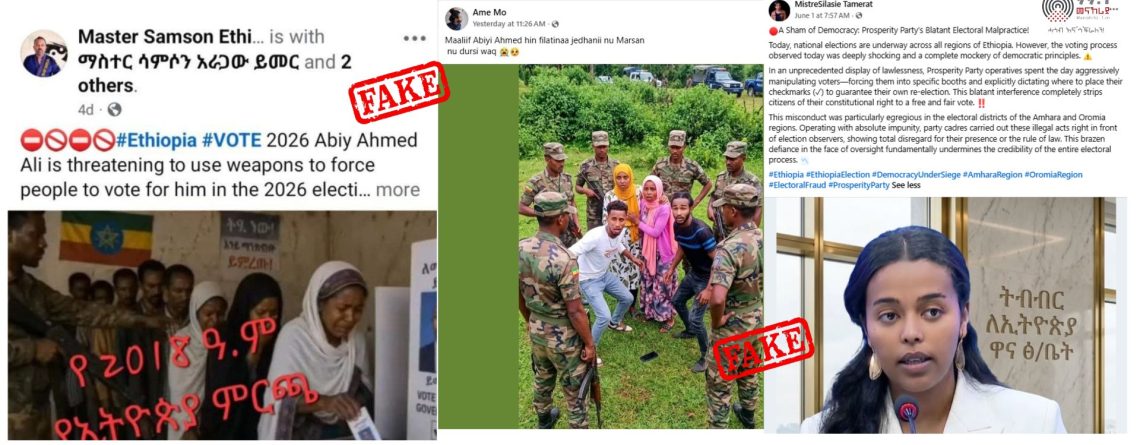
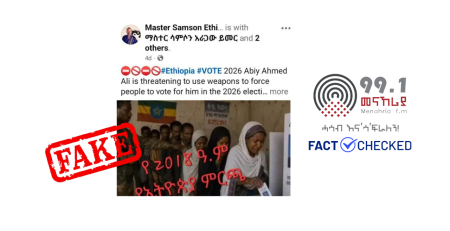
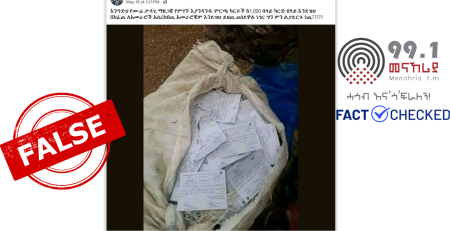
The first major milestone of this fellowship emerged in May, when a deeply unsettling video began circulating across multiple Facebook pages. The footage claimed to capture a volatile scene inside an active polling station, alleging that Ethiopian government forces were using heavy weapons to coerce terrified citizens into voting for Prime Minister Abiy Ahmed. Recognizing the immediate threat this posed to public safety and institutional credibility, Menahria Radio 99.1 isolated keyframes from the footage and ran them through Hive Moderation.
The system confirmed a 97.9 percent probability of artificial intelligence generation. A granular analysis exposed critical visual anomalies unique to deepfakes, including mechanical facial transitions where expressions snapped instantly from tears to terror, unnatural lip movements, and digital character distortion. Furthermore, the voting cards failed to function as solid objects, clipping directly through the subjects’ fingers, while the background Amharic script was rendered as scrambled, nonsensical typography. We cross-referenced these technical red flags with the National Election Board of Ethiopia’s regulatory framework, which strictly prohibits political branding inside polling stations, thereby successfully achieving our first milestone by exposing the entire scene as a malicious fabrication.
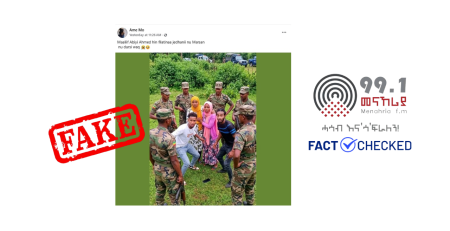
As the election concluded and the counting phase began in June, we achieved our second key milestone when an even more visually convincing piece of disinformation surfaced. A Facebook page named Ame Mo published an image depicting heavily armed security forces surrounding a group of young citizens, accompanied by a caption claiming the soldiers were demanding to know why they refused to vote for the ruling party.
This post generated hundreds of hostile reactions within hours, threatening to ignite severe post-election friction. Our investigative protocol immediately subjected the image to multi-engine reverse searches across Google, Yandex, and TinEye, revealing that the image existed exclusively on unverified social media handles and lacked any credible journalistic sourcing.
Closer inspection revealed fatal AI flaws: the military uniforms featured completely mismatched tactical designs and contradictory official patches, the star on the Ethiopian flag failed to touch the color bands evenly, and the citizens’ eye contact was physically impossible, staring uniformly at a blank space far above the soldiers’ heights. Hive Moderation confirmed a 99.9 percent synthetic probability, allowing our team to conclusively debunk the image before it could catalyze real-world violence.
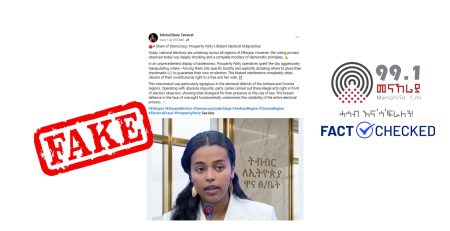
The final operational milestone of our election monitoring shifted from synthetic imagery to synthetic identities, focusing on the tactical weaponization of prominent political figures. In June, an imposter Facebook page mimicking MistreSilasie Tamerat—the Secretary General of the opposition Ethiopian People’s Revolutionary Party and a prominent candidate for the Coalition for Ethiopian Unity—released an explosive statement.
The post declared the election a complete sham of democracy and accused ruling party operatives of systemic booth manipulation. To verify the account, Menahria Radio 99.1 contacted the politician directly via WhatsApp. She explicitly disavowed the statement and the profile, noting that the fraudulent account held only 5,400 followers compared to her authentic, blue-badge verified page which boasts over 64,000 followers under the official handle MistresilasieT.
Additionally, the imposter page had anchored its fake press release with a synthetic image of an emergency briefing. Hive Moderation flagged the attached graphic as 99.9 percent AI-generated, proving that the organizational seal, typography, and the official’s likeness were computer-generated artifacts designed to manufacture a national crisis, rounding out our final investigative milestone.
The cumulative impact of these three successful milestones went far beyond merely correcting the record, delivering both immediate and long-term benefits to our audience. In a highly polarized environment, our rapid, data-backed interventions achieved a direct community impact by preventing fabricated media from morphing into physical civil unrest or violence against security personnel.
By pulling back the curtain on deepfakes and imposter profiles, we provided our audience at Menahria Radio 99.1 with the critical media literacy needed to evaluate election content skeptically, effectively diminishing the reach of bad actors.
Looking forward, our proposed impact focuses on long-term sustainability, as this intensive fellowship, supported by the technical expertise of PesaCheck and Code for Africa, has fundamentally upgraded our digital verification infrastructure. By transforming our newsroom into a resilient frontline defense against algorithmic deception, our proposed long-term impact will ensure we remain permanently equipped to safeguard historical truth, train emerging journalists, and advocate for an informed, media-literate society for years to come.
By Getahun Asnake



ምላሽ ይስጡ