


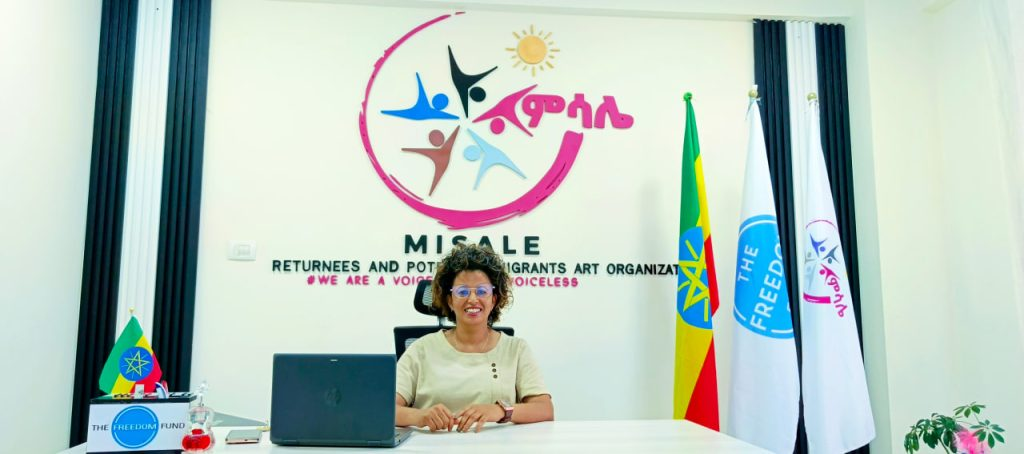
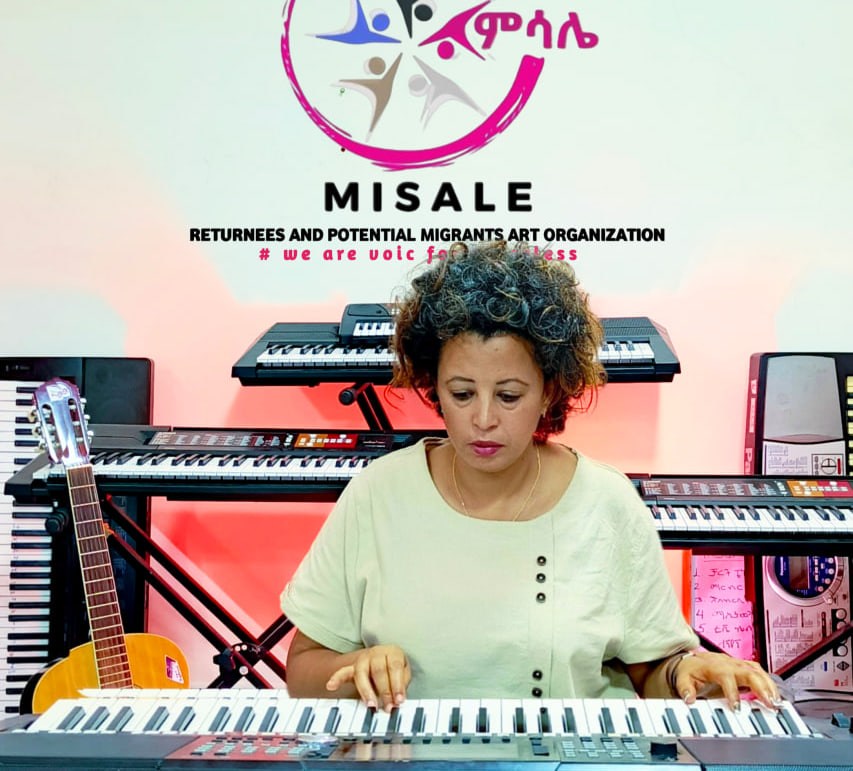
Under the open skies of Addis Ababa’s Lafto suburb, inside a modest, unassuming office, the sound of a piano echoes through the walls. This is no ordinary melody. It is a lifeline, a slow and steady rhythm carrying the weight of women who returned broken from irregular migration pathways. These are daughters, sisters, and mothers who were stripped of their dignity by deceptive brokers, left empty-handed, and deeply scarred by the quiet sting of social stigma. This sanctuary is known as Misale Returns and Potential Migrant Art Organization—a place dedicated to rewriting the tragic narratives of thousands of vulnerable Ethiopians, including a resilient survivor named Liya Sharew.
Liya’s story is a profound reflection of the wider migration crisis gripping the Horn of Africa. Born and raised in the bustling streets of Lafto, Liya spent her childhood dreaming of wearing a crisp white lab coat, imagining the days she would heal the sick as a physician. However, as the eldest child, the heavy mantle of family responsibility fell prematurely on her young shoulders. Her mother’s grueling days spent selling bread and injera simply could not match the country’s soaring cost of living, slowly darkening Liya’s childhood aspirations. Driven by a fierce, protective love for her family, Liya made a desperate pivot toward economic migration. She distinctly remembers the day her mother planned to migrate to the Middle East for a better life. Liya could not bear to see her mother suffer, stepping forward to take her place, unaware of the shadows that lay ahead.
At the time, finding work in Dubai felt like her only beacon of hope. Regrettably, opting for an irregular pathway—traveling on a standard tourist visa with the intention of overstaying—rendered her completely vulnerable to ruthless exploitation. To avoid the long, perilous overland foot journeys, she chose to fly out under the guise of a tourist visit, financed by an uncle under the promise that she would pay him back from her future earnings. The reality upon arrival, however, was a sharp betrayal. Intercepted by brokers, Liya was human trafficked deep into a remote rural area and isolated inside a massive four-story villa. There, she was forced to single-handedly manage a household of eleven children alongside the parents. For six agonizing months, she endured this overwhelming physical and emotional toll entirely alone, only to be denied every single penny of her hard-earned wages. It was in that moment of complete isolation that she realized she had been sold into modern-day slavery.
Desperate to escape, Liya managed to flee to neighboring Sudan, where she spent the next twelve years trapped in the precarious, fragile shadows of irregular migration. Just as she was beginning to piece a life together, civil war erupted across Sudan, layering displacement upon displacement, and ultimately forcing her to flee back to Ethiopia completely empty-handed. The trauma accumulated over her fifteen-year exile left deep psychological scars. During her long journeys across borders, she witnessed countless women being sexually assaulted by brokers and armed militia groups. The price exacted by irregular migration, she reflects softly, is utterly catastrophic, leaving wounds that standard news reports can never fully capture.
Experts analyzing these migration flows note that behind the statistics lies a critical, direct correlation between environmental degradation, climate change, and human trafficking. Ecological disruptions and sudden economic shocks systematically erode a family’s ability to survive, turning desperate citizens into easy targets for organized criminal networks. A seasoned migration policy expert, speaking on the condition of anonymity, explained that while regularized migration can be a potent driver for community development, irregular channels inevitably expose human beings to horrific exploitation. Climate change acts as a massive vulnerability multiplier, stripping away traditional farming and livestock livelihoods, and leaving desperate people with few choices but to fall directly into the traps of human traffickers.
When Liya finally set foot back on Ethiopian soil, she was battling severe Post-Traumatic Stress Disorder, carrying an invisible weight that made even waking up a challenge. It was during this dark period that Misale threw her a lifeline. Hiwot Dagem, the missale founder and director of the organization, utilizes music, painting, and expressive art therapy to guide returnee women through comprehensive trauma healing. Today, fortified by Misale’s psychosocial support and vocational training, Liya has successfully transitioned into an independent fashion designer, married, and built a peaceful, stable life. Her remarkable recovery serves as a powerful testament that with tailored, empathetic institutional support, returnees can rebuild, thrive, and achieve financial independence right within their home country.
To combat these transnational crimes, the Government of Ethiopia enacted Proclamation No. 1178/2020, which institutes stringent penalties for perpetrators. Under this legal framework, individuals convicted of human trafficking or migrant smuggling face rigorous imprisonment ranging from fifteen to twenty-five years, coupled with heavy financial penalties between fifty thousand and one hundred and fifty thousand Birr. If the trafficking or smuggling operation results in the tragic death of the victim, the law mandates harsher sentences ranging from life imprisonment to the death penalty, alongside fines up to two hundred thousand Birr.
To protect citizens from falling victim to these illicit rings, migration experts strongly advise aspiring migrants to utilize regularized, safe pathways, such as the bilateral labor migration programs facilitated by the Ministry of Labor and Skills. Concurrently, the International Organization for Migration continues to play a vital role in Ethiopia through its CREATE project, which aims to foster safe, orderly migration management and sustainable socio-economic reintegration for returnees.
Ultimately, eradicating human trafficking requires a deeply human, multi-sectoral approach across the IGAD region. Seamless, empathetic coordination must be maintained between state agencies, regional bodies, international organizations, survivor-led NGOs like Misale, and mainstream media outlets. Furthermore, local communities must consciously dismantle the deep-seated social stigma and unrealistic expectations often imposed on returnees, replacing harsh judgment with empathy and structured community support. Citizens are also encouraged to play an active role in community protection by utilizing institutional hotlines, such as the national anti-trafficking toll-free hotline at 8797 or the Ministry of Justice call center at 6073, to report suspected smuggling operations or access verified information.
While Liya’s harrowing odyssey exposes the raw, human cost of irregular migration, her ultimate triumph proves that through collective regional efforts, robust policy frameworks, and innovative healing mechanisms, broken lives can be beautifully restored. Her story offers a timeless lesson for the entire Horn of Africa: that it is entirely possible to resurrect lost hope, heal from the deepest of wounds, and forge a prosperous, dignified future at home.
Here is the Amharic version of the article: Amharic Article
By Getahun Asnake, Senior Journalist and Social Media Manager, Menahria Radio 99.1
Addis Ababa, Ethiopia
Published on: June 11, 2025


ምላሽ ይስጡ